✍️ Ivan Sørensen
Welcome to this week's installment of Wandering the Tides, where we check on the progress, successes and tribulations of the two Halifax football clubs: The Halifax Wanderers and the Halifax Tides.
The Wanderers
The Wanderers’ Canadian Championship run unfortunately proved short-lived, as a rematch with Forge ended in a heavy 4-0 defeat that left little room for debate.
Cup luck has not been on Halifax’s side for some time now, and this year proved no different.
With the club still in something of a transition period, there is an argument that focusing solely on league play could become an advantage moving forward. Still, the elimination stings, especially in a Canadian Championship round where several notable upsets took place elsewhere.
Back in league action, the Wanderers travelled to Ottawa to face a side that had struggled domestically but was coming off a statement victory over MLS opposition in Toronto FC.
It was immediately clear that the tactical instructions had changed. Halifax sat very deep throughout the first half and rarely ventured beyond the halfway line, seemingly content to allow Ottawa possession and force the hosts to expend energy trying to break them down. The occasional long ball forward looked to spring a counterattack, but very little came from those moments.
Unfortunately for Halifax, Jonantán Villal found the breakthrough for Ottawa with a fairly unlikely effort that somehow bypassed three defenders and goalkeeper Marco Carducci.
The half ended with the Wanderers failing to register a single shot. While they did limit Ottawa to only five attempts of their own, it was obvious that some tactical adjustment would be required to chase an equalizer.
The second half saw far more energy from Halifax, as the side attempted to strike a balance between disrupting Ottawa’s rhythm and creating counterattack opportunities. The Wanderers finished with seven shots overall, but none managed to find the back of the net.
Perhaps the defining moment came in stoppage time, when a remarkable bounce off the post at 90+4 denied Halifax with the goalkeeper stranded off his line. It felt like a perfect summary of the club’s recent fortune. Vanni Sartini later described the moment as “the synopsis of the moment,” suggesting that when the footballing gods are against you, very little seems to go your way.
How have the @HFXWanderersFC not scored here 😱
— OneSoccer (@onesoccer) May 17, 2026
🔴 Watch #CPLSoccer on OneSoccer pic.twitter.com/igGrakdALR
In the post-match discussion, Sartini appeared relatively satisfied with the overall performance. The team had executed the intended game plan of sitting deeper and allowing Ottawa to dominate possession, though he admitted the attacking output still needs improvement.
Still, despite the defeat, it was the Wanderers’ first scoreless league match of the season.
The Tides
The Tides took on Ottawa on a damp and cold afternoon, with rain that steadily intensified as the match went on. The conditions created a slick surface that kept the ball moving quickly and caused problems for both sides throughout the game.
Despite that, Halifax came out aggressively and played a strong opening half hour. The Tides registered eight shots and forced six corners during that stretch, looking dangerous despite Ottawa controlling more of the possession.
Miller and Rhodes played key roles in trying to create opportunities going forward, but Ottawa’s opener in the 35th minute felt like a major blow to the team’s confidence and momentum.
The second half turned into a much more difficult battle.
Ottawa’s midfield increasingly took control of the match, making it harder and harder for Halifax to break the press or build meaningful counterattacks. Offensive opportunities became far more scattered, while the defensive pressure continued to rise. Both Allen and Vallerand picked up yellow cards as the physical battles intensified.
It was very much a game of two halves, and by the final whistle, Ottawa had secured a 2-0 victory.
For Halifax, it was likely a long and very wet trip home.
The Tides returned home on Monday and suffered a 2-1 defeat to Vancouver Rise, a side they have yet to beat since the Northern Super League’s introduction.
Despite creating more chances, Jordyn Rhodes’ equalizer was cancelled out just minutes later by a Quinn penalty.
And a chat with Stephen Hart
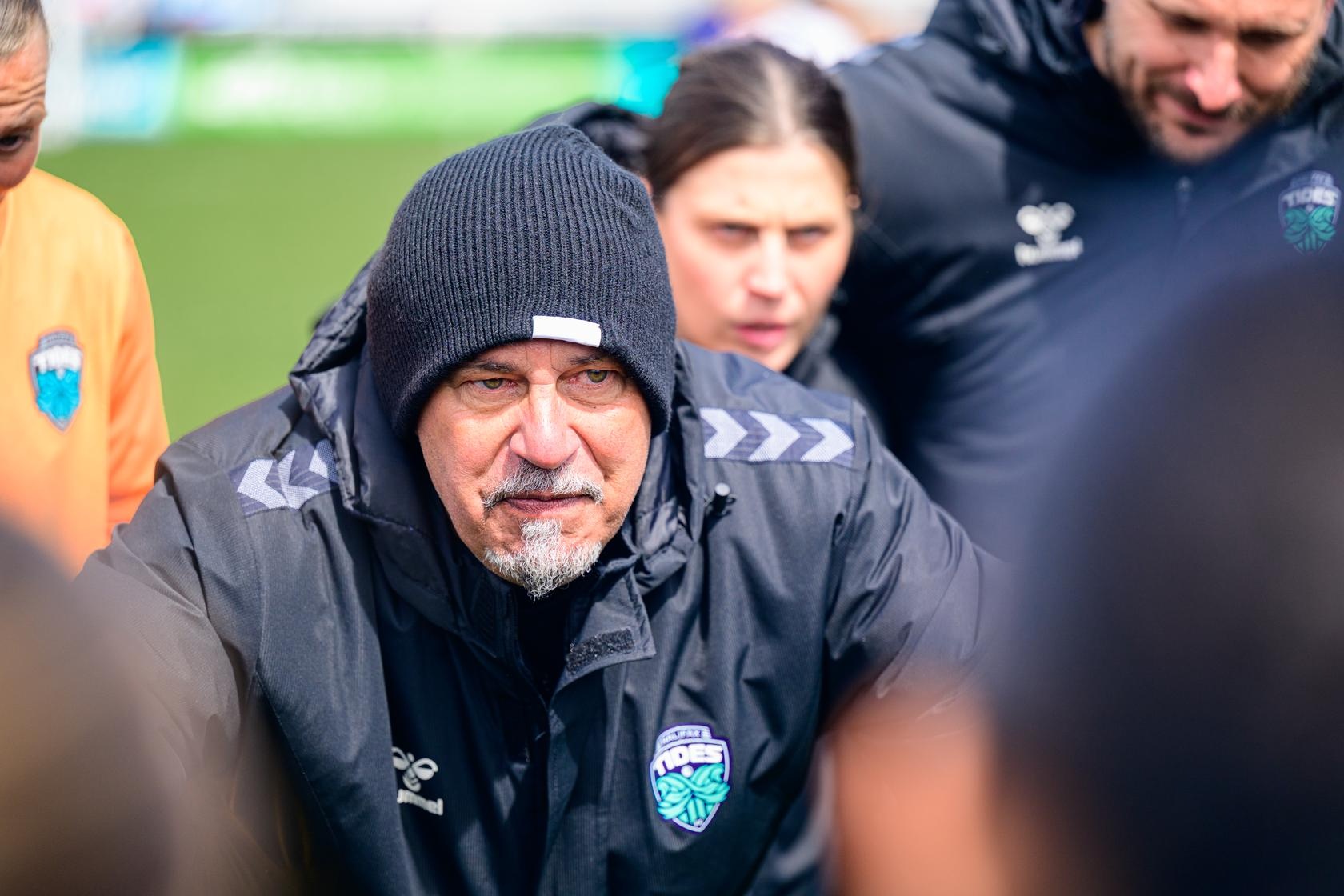
Head coach of the Halifax Tides, Stephen Hart, was kind enough to sit down with me to answer a few questions about coaching from the inside.
Over the course of his career, Hart has worked across nearly every level and environment in the sport: youth teams, senior teams, men’s football, women’s football, national teams, club sides, and multiple countries. When asked how those experiences required different approaches, he explained that one of the biggest challenges with international football is the lack of time. With national teams, coaches often only have a few days with players, whereas club football allows for daily work on the training ground.
Hart also emphasized that coaching youth players goes beyond developing footballers. Especially at the U15 level, he said, coaches are also responsible for helping shape good individuals. One point he highlighted was the importance of properly supporting tactically gifted players who may not yet be physically developed, ensuring they receive training appropriate to their current stage.
When discussing the differences between coaching men and women, Hart explained that women’s teams often operate in a more group-oriented way, something coaches need to consider when assigning tasks or managing training dynamics.
The conversation also shifted toward his approach away from the tactical side of the game. Hart said he tries to coach with “some empathy,” recognizing that players are balancing football with family situations, emotions, and life away from the pitch. At the same time, he stressed the realities of professional sport.
“There are only 11 players that will start,” he explained, noting that coaches constantly have to balance individual interests with what the team needs overall. Players, naturally, are focused on maximizing their own opportunities and minutes.
Throughout the discussion, it became clear that Hart approaches coaching with a highly professional mindset. Expectations, in his view, need to be clear at all times.
I also asked how he handles players who are not currently receiving significant minutes. Hart explained that reassurance is important, but so is helping players understand that their focus must remain on training and improvement so the coaching staff can prepare them when opportunities arise.
Tactically, Hart said his priority is situational awareness, developing players capable of recognizing moments in matches and making the correct decisions accordingly. It is an approach that perhaps explains the freedom and fluidity Halifax showed during its strong opening performance against Ottawa earlier this season.
Since it was something discussed previously during my interview with Addy Weichers, I also asked Hart about the transition many players make from college soccer to the professional level, particularly relevant in the NSL, where numerous players have taken that step recently.
Hart described the adjustment as fundamentally about professionalism and responsibility.
“It’s a job now,” he explained, adding that the daily demands and expectations can represent a massive lifestyle change for many young players entering the professional game.
From there, the conversation moved toward Halifax’s difficult 2025 season and the work done during preseason. Hart arrived after the campaign had already begun and inherited a challenging situation while attempting to steady the club.
Looking back, he said he was extremely proud of how the team managed to hold together through difficult moments. He also pointed to preseason matches against strong opposition as an important source of confidence heading into the new campaign, something that was clearly visible during Halifax’s opening performances this year.
Finally, we discussed Halifax itself as a football city, something especially meaningful to Hart given his years as technical director at Soccer Nova Scotia. Having coached in front of Halifax crowds with both the Wanderers and now the Tides, Hart had nothing but praise for the supporters and the atmosphere they continue to create.
By the end of the conversation, the impression left was of a practical coach, demanding and unwilling to hide behind excuses (when I mentioned the wet conditions against Ottawa, he dismissed the idea almost immediately), but also someone who genuinely cares about the players placed under his guidance.
Standings
Without points this weekend, the Wanderers now find themselves in sixth place with five points through six matches. If you are an optimist, half of those games have not ended in defeat. If you are a pessimist, half of them have.
Saturday brings a home match against Inter Toronto, a side Halifax is often viewed as relatively comparable to, but one that has enjoyed a very strong start to the season. Still, Wanderers Grounds has a way of changing the mood around this club quickly, and the home crowd could play an important role once again. Three points here would immediately push Halifax right back into the playoff conversation.
The Tides, meanwhile, sit fourth in the standings with four points from a win, a draw, and a loss.
Monday sees them take on a still-winless Vancouver side, while the following weekend brings another matchup against a Calgary Wild team also searching for its first victory. It feels like a vital stretch for Halifax: an opportunity to regroup, collect six important points, establish a stronger foothold in the standings, and, perhaps most importantly, rebuild confidence within the squad.