This week, I am excited to bring you an interview with Addison "Addy" Weichers: the Halifax Tides' number 16, born in Utah.
Weichers got her career start in the US college soccer system, playing for Utah State, then joined the Minnesota Aurora when the USL-W league began in 2022 (an American pre-professional league that began in 2022 under the USL organization).
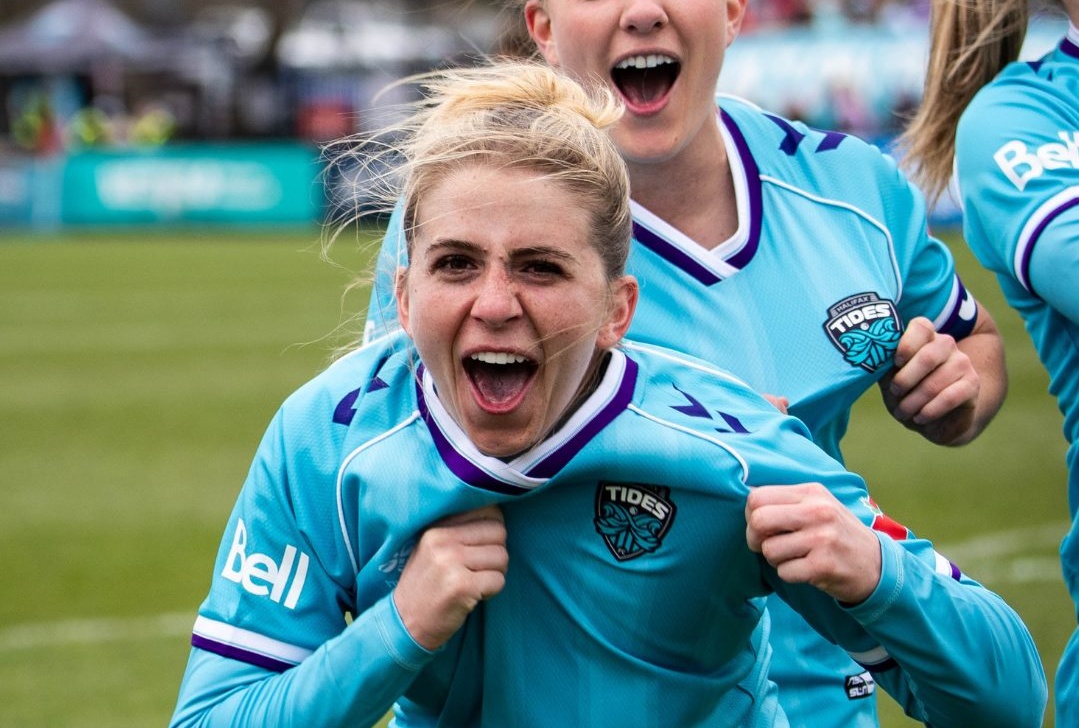
After 34 appearances in Minnesota, she moved on to her first fully professional role as a defender for the Halifax Tides, playing 19 matches in the opening season and scoring the first goal of the team in 2026.
Addy Weichers is turning the Tides 🌊 pic.twitter.com/sjBdUtJkJY
— Northern Super League (@NorthernSuperLg) April 25, 2026
Addy was kind enough to sit down to talk about her career and her experiences. She has played as a defender for more or less all of her career, including at the Tides.
"Yeah, yeah, so it's funny, when I was like little little, I started as a forward and then made the transition to defender. And throughout high school, I played centre back but a little bit outside back, and then once I went to college, I was like full centre back, and then in the summers, I would play on a summer team in Minnesota, Minnesota Aurora, like a USL-W team, and I would play the 6 there actually, but during my college career, I only played centre back, and then yeah, once I came to Halifax I've been playing centre back. I've like dabbled at fullback a little bit, but just centre back in the real games."
When asked whether this came from coaches picking that role or whether she naturally gravitated to the defender role, she replied:
"I would say probably coaches, and what I gravitated to. I would say that kind of plays into my strengths. I would say I'm definitely better at like a central role in terms of being able to play out. I would say that's one of my strengths, and so, yeah, I would say a mixture of both."
She went on to describe her style as a defender:
"I would say my composure and leadership in a way of organization. Organizing a team, then yeah, playing out, like positioning and helping my teammates in their position."
It is worth remembering here that Halifax only conceded a single goal in the two opening matches of the season.
We talked about the process of moving through the career ladder, having played in college, pre-professional, and now a fully professional league. Weichers explained her mindset throughout the journey:
"I think just a level of maturity comes with each stage you progress. I feel like, especially last year, transitioning to pro, there are a lot of realities and things you learn that can't necessarily be taught other than through experience."
"I feel like this last year playing has really changed my game, in the sense of my mentality, in terms of not taking losses or mistakes so personally and learning from the leaders, seeing the game for what it is, which is like sports — your game has mistakes and those are just realities that come with it, and the more, the faster you can accept that mistakes are a reality, the better and quicker you can move on from them.
And so I think that's kind of a big thing I've seen, just moving forward, is how can I better myself and better my team in a way that is productive, constructive and not so emotionally attached."
On learning from the difficult season in 2025:
"Like last season, we didn't have a great season, and so I think you just have to lean into what you can learn from each loss and not take it personally."
Having played for multiple teams, of course, means also playing under multiple coaches (including two at the Tides). We talked about how these things change as you move from coach to coach:
"Yeah, I think it is taking from each coach what I can and applying it, and then learning from the next one and what they have to give. In college for example I had a coach that was very, very structured, like we had PowerPoints, we had like an hour of film before every training, we could also do personal film so many times a week, and so I went from super structured to more generic when I came here, which I then had to learn how to be more free-flowing and creative and just see what the game gives you.
And so I think it's cool to kind of see how each coach sees the game and the little things that they notice that help you be better. I think Stephen is really good at reading the cues of different players, like okay, if this player, if I am playing against a forward, for example, and they keep checking, can I bump them and be physical? So they can't run past me? You know, things like that.
I think just adding on to each one and then building your game from there. But yeah, it is interesting, I have had so many coaches throughout my life that you get used to kind of constantly trying to prove yourself and learn from them."
On the topic of film, I had the thought of whether it ever gets awkward watching yourself on film:
"I think I've gotten used to it. I tend not to watch the broadcast version, just so I can see more of the overview, and that helps kind of just separate it sometimes. But yeah, sometimes I am like 'Wow man, I really thought I looked cooler here'."
Rounding out the discussion about the personal journey and her first professional contract, Weichers also noted about her family when she finally got her professional call-up:
"They were just so excited and happy for me, and they've been part of my journey for so long, so I think it was kind of a win for all of us when I got the call."
I asked whether it happened at a time when she felt she was 100% ready for the professional level:
"I think my goal was definitely to go. Yeah, I think I was ready, it was more just if there was the opportunity when I was trying to play.
I was calling a bunch of teammates who had gone pro, just to get their advice and those sorts of things, and one of my teammates said to me, getting your first contract is a lot about luck and timing, just because of different windows and what other teams need and what positions and those sorts of things. I totally felt that just looking and then hoping that the right opportunity was right for me."
Weichers is in the somewhat unique position that she has now twice played in a brand new league (USL-W and now the Northern Super League):
"Yeah, it is cool to see just how much it grows over the years. And it's also cool, I think about when I have kids one day, and I would love it if my girls one day play soccer, if I have daughters. But it's cool to be part of those milestones, and I can't even imagine what that will be like when they're playing as well.
All these founding things that are progressing sports, especially female sports. It's cool to just see, and then from this year to last year at the Tides, they've just made so many improvements and been so open to feedback from the staff, organization, from the players, and so it has been cool to just see how the investment is there and trying to make it as good as possible."
To put things into context, when Addison was born in 2002, professional women's football basically did not exist in North America. Today, there are 31 professional teams across the NSL, NWSL, and USL Super League.
"I feel very lucky, it's cool, I'm excited. Like I imagine once I'm done playing, whenever that time is, that I'll look back and be like 'Oh, I can remember when it was like this,s and there were only 6 teams'."
I asked about where she feels she is in her development as a player currently, and with her professional debut:
"I think I have so much to grow. I think I feel like last year, I really tried to take the opportunity to learn and grow as much as I could, and I feel like it's hopefully showing more this year, but I have so much to go. I have so many ideas and plans for where I want to be in terms of how I play.
And I mean, I do want to play as well as I can, and I feel like things are going better in terms of learning and stuff from last year, but yeah, I think I have so much to go, and I'm excited to hopefully continue to show that."
One might note that scoring the season-opening goal for the team as a defender is a pretty good starting point.
When talking about the two opening matches (against Ottawa and Toronto), she said about the Ottawa match:
"Oh yeah, I think it was good to just show that we're a better team and we're not the same team from last year. We have a group of players who are very composed and smart. And so I think it was really cool that we were able to show that. We had a really good pre-season in England where we played some hard teams, and so I think it was cool to just show that our preparation had paid off."
Regarding Toronto:
"To come out with a draw against Toronto, I think, was a win for our group in terms of being away at their home opener. I think both teams had chances, it wasn't like the most pretty game I would say on either end, but for us to do that, I think it was good. And also, it's good to get different types of games in terms of we were able to score quite a few against Ottawa, some set-piece goals, I think our defensive block and our press were good.
Then going into Toronto, I think it's a good opportunity to learn from grinding out a 0-0, how to manage the clock, how to deal with their formation, which is different from how a lot of the other teams play. So I think just good learning lessons and also just shows a lot of progress, and hopefully we can build on that and make them even better."
One of the things that really stood out compared to some of last year's games was the degree of confidence the team plays with now, and I wondered how much of that was also a reflection of head coach Stephen Hart being in place from the start of the season.
"Yeah, I think our pre-season was really good. We came in, and I think we've had a lot of meetings with our staff and everything, and they did a good job — we have like our building blocks, and they've been kind of building it brick by brick.
We have like this whole layout of our structure, and so I think they've done a good job at incorporating things like our press, how we build out, those sorts of things, and working on individual things and positions to get us prepared. And then we had 3 good games in England to get us prepared for the season, and I think that was really crucial, just to get really prepared and ready.
But I think we have a very complete staff as well. We got Steve and Sophie this year, and they've just been so great in terms of individual work and positions, and that's been really, really helpful in terms of just working on the little things. Like, how do we play out of this situation? We're doing a lot more individual film, those sorts of things, that I think are the details that have helped us as well."
I took the opportunity to ask where the balance tends to sit when it comes to drills and plans versus improvising moment to moment.
"I think it goes back to principles. Like in this situation, what is our principle? Do we protect the middle? Do we delay? But I think our staff is doing a good job at giving us cues, like when to recognize. Are they pressing? Are they not pressing? Is this person here?
They are teaching us these cues so we can make these decisions faster. Which I think is really good in terms of helping us just better our play and better the team and make quicker decisions."
When asked how those processes had changed when moving to a professional level:
"Yeah, because I think the margins are smaller here. Like, there's not a big gap between players. I mean, obviously, you still have the stars and people who really excel, but like everyone is good. Everyone can finish an opportunity. Everyone can pass the ball really well. Everyone's touch is really good.
I think that is something I have really noticed going into the professional game — the decision-making is better. People's touches are better. The speed of play is faster, and their movement is really good, like the timing of runs is really good. And so I do think the details are what separates people more at this level, and people are better at reading these cues faster."
We talked a bit about how you prepare for particular opponents versus in general:
"I would say it depends on who you ask, because I'm somebody who really likes to watch a lot of film. And other people might find that it makes them overthink. So for me personally, I watch a lot of film on who we are playing, just so I can see their tendencies. I'll usually watch a couple of their games the day before, or the night before, or two days before.
We also have our scout from our coaches, who is really good in terms of team principles, and they give us individual clips. So they are really helpful with that, and then yeah, I tend to watch how other teams play out against another team. So I watch a lot of games preparing for it, but it just depends on who you ask."
Canadian sports leagues are known for difficult travel distances. It is a cool 6,000 kilometres from Halifax to Vancouver if you were planning on driving it, supposedly one of the longest away trips in global football.
I asked her how you adapt to that:
"Yeah, I think it's easier to go there than to come back. Going there, it really isn't a problem, but it is when we come back. It's actually harder, I think. But I mean, it's nice that we have a couple of days off in between. We usually have like one day that we can just get adjusted, like a day off when we get back. But yeah, when we go multiple times in a row, it does get tiring, that's for sure."
Rounding out the conversation, I asked whether she watches football for fun as well:
"Yeah, I watch a lot of NWSL. I know a lot of my teammates watch the Premier League and Champions League. I also watch WSL, but mostly I would say NWSL."
"I watch a lot of Utah Royals because I am from Utah. And they are doing well this year! It's been really cool. Usually, if there is an NWSL game and I know it's going on, I'll just watch it."
I asked if there was a particular moment growing up that really lit the flame for the sport:
"I would say I grew up watching a lot of the USA women's team. That's a team I really watch — like any time they have a game, I'm watching. Actually, I met Megan Rapinoe when I was younger, and that was like, really cool in terms of like, wow, I want to play for the US so badly. I actually didn't think it was possible for me to play professionally until I got to college. It just didn't seem like a reality for me at the time because there was only the NWSL that I knew of. And so I think it was something I always wanted to do."
A good reminder of just how much the professional women's leagues really mean and how much they matter to young players growing up and forming the next generation of professional players, and the generation after that, and so on.
As a final question, I broke out some really hard-hitting journalism.
Does she prefer the Halifax kit from last year or this year? Turns out she prefers the current simple teal look.
Final closing remarks then?
"Go Tides! Everyone, support the Tides. Get your jerseys! Come to the games!"
I think we can all rally around that.