.jpg)
The Canadian Premier League has announced several changes ahead of the 2026 season, set to kick off on April 4. The league enters its eighth campaign, with one change in particular drawing attention from across the world.
New playoff format
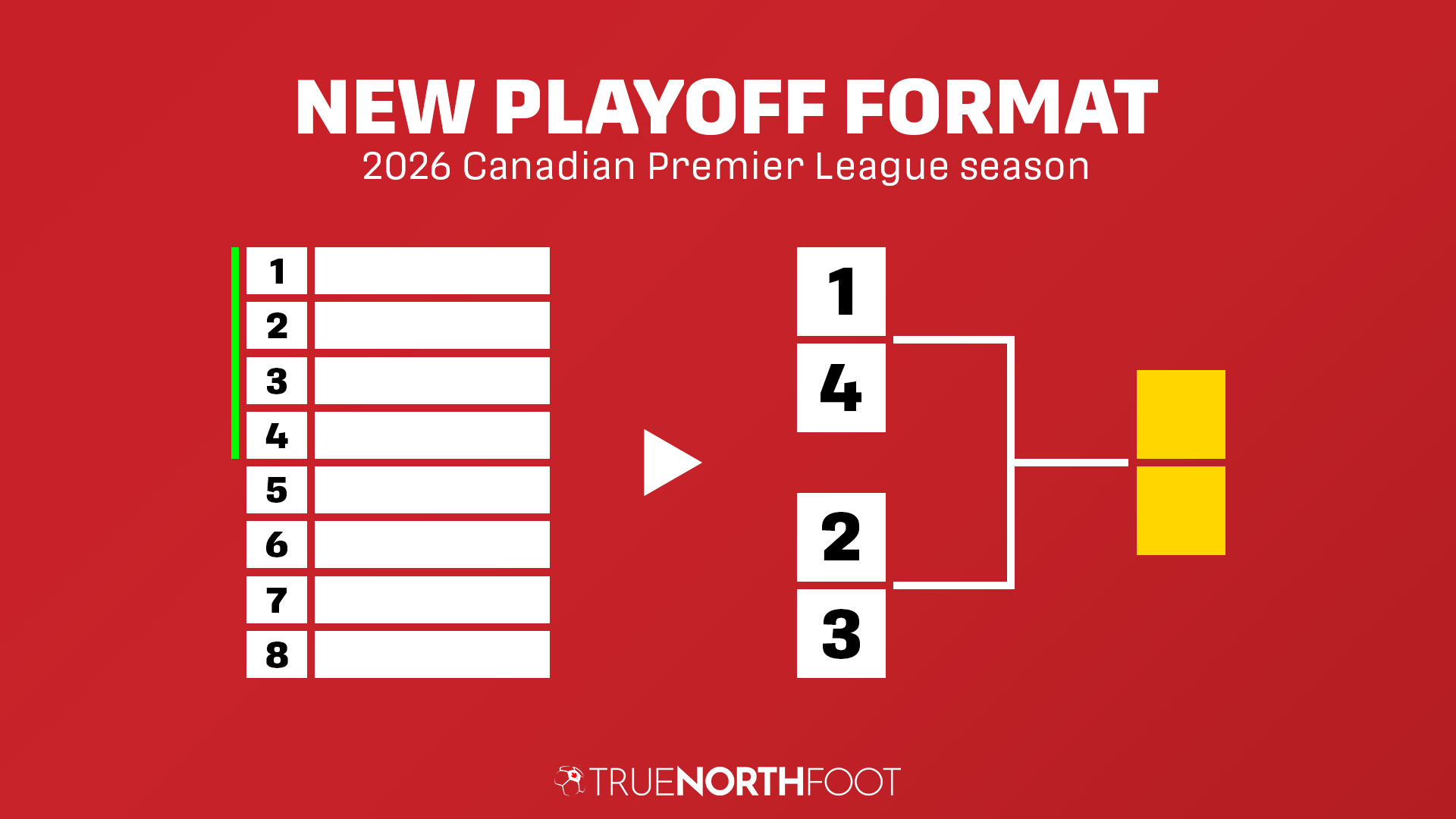
The league is reverting to its 2022 playoff format, with four teams qualifying for the postseason.
The semi-finals will be played as two-legged ties, with the first-placed side facing the fourth and the second facing the third, with the higher-ranked side hosting the second leg.
The final will remain a single match, though this time the top-ranked team will have home advantage.
The format was used for just one season in 2022 before the switch to a five-team playoff structure in 2023, which was retained for the following two years.
Offside trial
As has been widely reported over the past month, the Canadian Premier League will trial a new offside rule in 2026.
Dubbed the "Wenger Daylight Rule," an attacking player will be considered onside if at least one part of their body that can legally score a goal is level with or behind the second-to-last defender. A player will only be ruled offside if there is a clear gap between themselves and that defender. The trial will be conducted in collaboration with FIFA.
"This is about positioning the Canadian Premier League at the forefront of innovation and contributing meaningfully to the global evolution of the game," said James Johnson, CSME CEO and commissioner of the Canadian Premier League, in a statement. "By working closely with FIFA and IFAB, we are proud to play a role in shaping the future of football while continuing to build a competition that reflects our ambition here in Canada."
The CPL is leading the line on innovation ⚽️🇨🇦
— Canadian Premier League (@CPLsoccer) March 31, 2026
This season, we’re trialing the “daylight offside” rule, approved by IFAB and in cooperation with FIFA, to enhance attacking play and match flow.
Starts Saturday.#CPLSoccer pic.twitter.com/q3dxPUJsFA
Football Video Support
As part of the offside trial, Football Video Support (FVS) will also be implemented throughout the 2026 season, including the playoffs.
The system is similar to VAR in that it uses available broadcast footage to review key incidents, but unlike VAR, there are no dedicated video match officials. Instead, reviews are initiated by the head coaches themselves, with each coach allocated a maximum of two challenges per match for match-changing situations such as goals, penalty decisions, red cards, and cases of mistaken identity. When a challenge is made, the first official will review the footage on the pitchside screen.
A successful challenge sees the team retain their card, while an unsuccessful one results in it being forfeited. Football Video Support was first introduced in 2024 and was most recently trialled at the 2025 FIFA Under-20 World Cup.
Reducing time-wasting
The league will also adopt a package of anti-time-wasting measures designed by FIFA and approved by IFAB, which will also be used at the 2026 FIFA World Cup and all other FIFA competitions.
Under the new rules, if a referee determines that a throw-in or goal kick is being deliberately delayed, a five-second visual countdown will be initiated. Failure to put the ball in play before the countdown expires will result in the throw-in being awarded to the opposing team, while a delayed goal kick will hand the opposition a corner kick.
Players being substituted off will be required to leave the field within 10 seconds of the substitution board being displayed. If they fail to do so, the incoming player must wait one minute of playing time before being allowed to enter the pitch.
Finally, any player receiving treatment on the pitch for an injury will be required to leave the field and remain off for one minute of actual playing time before returning.
Roster regulation updates
The player salary cap will increase to $1,337,500 CAD per club for the 2026 season, up from $1,282,000 CAD.
The higher figure is achievable through the league's U21 player incentive, which sees players under 21 count against the compensation budget at 50% of their total compensation, up to a maximum of $120,000 CAD per club, increased from $100,000 CAD last year.
A new U-21 Graduate Provision will allow eligible players entering their U-22 year to remain at or sign a new contract with the same club, counting at 80% of their compensation toward the Player Compensation Budget. To qualify, the player must have spent at least two seasons with the same club, not while on loan from another side.
Clubs may now also carry up to three Exceptional Young Talent U-18 players on the Developmental Roster. Additionally, if one of those EYT-designated players is a goalkeeper, the club may choose to carry just one goalkeeper on its Primary Roster.
The Canadian Premier League season gets underway on Saturday, April 4, with a double-header. Forge face Atlético Ottawa at 12:00 pm ET / 9:00 am PT, before Vancouver FC hosts Halifax later that day at 4:00 pm PT / 8:00 pm AT.