✍️ Andre Schaffner
Canada came through with a 1-0 win over Chile to open their three-match September-October window. It wasn't their best game, but it wasn't the worst either. After watching the game live and then rewatching the broadcast a few days later, I came away with a different mindset about the performance. My initial thoughts were more critical than they were after watching it back.
Just two years ago, a 1-0 win over a South American team would have been cause for celebration, but expectations are higher now, and the way the game played out made the final score seem underwhelming. In a game where nearly half the preferred starters were absent, and several new players were thrown into a friendly with eight substitutions, the result was somewhat understandable. This is not to say there were no signs of concern or that all was well with the performance.
The match played out in three acts. The first ran from the start to Chile's first red card in the 34th minute. The second covered the second dismissal early in the second half through Marsch's first quadruple substitution. The third act was the remainder of the game, where all the starters except Dayne St. Clair, Richie Laryea, and Mathieu Choinière were substituted out.
In the first act, Canada looked comfortable and in control, largely executing their game plan, with an early Jonathan David goal suggesting more to come. The second act was probably the most concerning, as the wheels came off the game plan with the Chilean red cards. La Roja were now largely defending for their lives and rarely seeking possession. This is when Canada ought to have stayed on the front foot and taken the game to their opponents. They did not.
Finally, after the raft of substitutions, Canada's play looked cumbersome as new personnel took time to get up to speed with the feisty defensive performance Chile maintained. The changes on the field disrupted what flow and rhythm there was, until late in the match when the replacements began to find some opportunities but still failed to convert. Canada's finishing — or lack thereof — was the overarching theme throughout the game.

This was disappointing, as the opponent is going through a generational rebuild and, quite honestly, was not very dangerous going forward, aside from a few plucky counter-attacks. Chile, as expected, provided the spirited and sometimes over-aggressive play South American teams are known for, but the overall quality in their line-up was not high.
The Canadian performance left varying impressions. Here are some takeaways across the three main facets of the game — defensive work, offensive efforts, and set-piece play — as well as what appears to be developing into Canada's Achilles' heel.
Set-piece play
I will begin with Canada's set-piece performance. At the outset, Canada looked inventive without overcomplicating their corner kicks in the first half. Having one of the better set-piece takers in the line-up, Mathieu Choinière, was helpful in this regard.
The first corner was a refreshing change from the predictable and often ineffective lofted balls into the box. Missing their usual height advantage may have helped explain the creativity on display. That first corner was taken short, a rehearsed play from the training ground, with Choinière passing to Jonathan David, who quickly played the ball to the top of the box for the onrushing Jacob Shaffelburg. The attempt caught the visitors off guard, though unfortunately Shaffelburg got under the ball and it sailed well over. It was exhilarating to watch, even if the play didn't come off as planned.
Throughout the opening half, Canada's corners were more varied and inventive than in recent memory. It was mildly disappointing that as the game moved into the second half, the team reverted to old stale habits. While it is not reasonable to expect a goal from every set piece, it would be encouraging if Canada continued to look more creative and threatening in these situations.
The rusty but impenetrable defensive performance
The game with Chile ended in a clean sheet, so all should be well with Canada. To begin with, Dayne St. Clair put in an excellent performance between the sticks while managing a young, experimental back line, where the most experienced centre-back earned his 19th cap at 20, and the oldest was 23, earning just his fifth cap. The evening ended with a centre-back pairing of 21-year-olds, one earning a fourth cap and the other making his senior team debut.
St. Clair put in a solid performance; he wasn't called upon often but still made a pair of critical saves when needed. In all, he made three saves, acted as a sweeper off his line once, and showed excellent distribution, completing 25 of 26 passes — a 96% clip — on the night.
The starting centre-back duo of Luc de Fougerolles and Ralph Priso had a few nervy moments early in the match, though this is understandable given de Fougerolles' club situation at Real Salt Lake, where he has yet to feature due to immigration paperwork delays, and Priso having had limited minutes recently while recovering from injury. Although their partnership wasn't quite in sync at the start, de Fougerolles' positional guidance for his converted midfielder partner showed maturity beyond his years. As the game progressed, both grew into it despite some worrying moments early in the first half.
While de Fougerolles took time to shake off the rust, Priso still looked unsure of himself and occasionally out of place, though he only took up playing centre-back at professional level on occasion just over a year ago. He struggled early with his positioning and at times seemed to lack confidence, but that doesn't mean he was poor on the night; his passing range was very good, and his ability to pick out Jacob Shaffelburg down the left flank was critical to the build-up of Canada's early goal. His decision-making and ability to read pressure also improved as the game progressed.
The introductions of Jovan Ivanišević for Priso, and later Jamie Knight-Lebel for de Fougerolles, brought a measured amount of stability and familiarity to the centre-back position. Despite some spirited Chilean counter-attacks, the young pairing physically imposed themselves on an opponent who sought to challenge their youth and lack of international experience in the late stages.
Both Ivanišević and Knight-Lebel impressed in the second half to close out the game, with the latter coming close to doubling Canada's lead in the dying minutes. Both have made a strong case for more opportunities and, along with de Fougerolles, represent the future of Canada's centre-back corps.
Minutes Jovan and Richard won’t soon forget 🍁#CANMNT pic.twitter.com/D6ohUDrSdX
— CANMNT (@CANMNT_Official) September 28, 2026
Regarding Ivanišević, Marsch remarked post-game: "I liked the little we saw — liked his mindset, body language, comfort in the role, very promising stuff. But he'll have to find a more competitive league context to keep developing." Ivanišević currently plays club football in Bosnia, but there has been talk of him moving on to bigger challenges as early as the upcoming winter transfer window.
The final result was a 20th clean sheet in Jesse Marsch's 38th game as Canada manager, a remarkable stat line for manager and country alike. While the defensive performance wasn't perfect in every aspect, it remains a great accomplishment that reflects well on Marsch's style of play. The criticism is that clean sheets in non-competitive games against lesser opponents have not always translated into the team's performances in competitive matches against stronger opposition.
This is reflected in how Canada fared at the recent World Cup, where they shut out the teams they were expected to handle with relative ease — Qatar and South Africa — but conceded in the three games where they dropped points. But this begs the question: does the defence need to be perfect for Canada to get a result, or does the attack need to step up? Indications suggest it is the latter.
Was Canada's attack sputtering or just unlucky?
Canada controlled the game before Chile went down to ten men. But when Chile lost another player early in the second half, expectations from the Canadian perspective were that an opportunity to run up the score was now on offer. Yet Canada could not find the back of the net for the remainder of the game. Marsch reflected after the match: "Chile remained aggressive even down two men. The way to make them pay was to be cleaner with the ball and cleaner with ideas and actions around the goal."
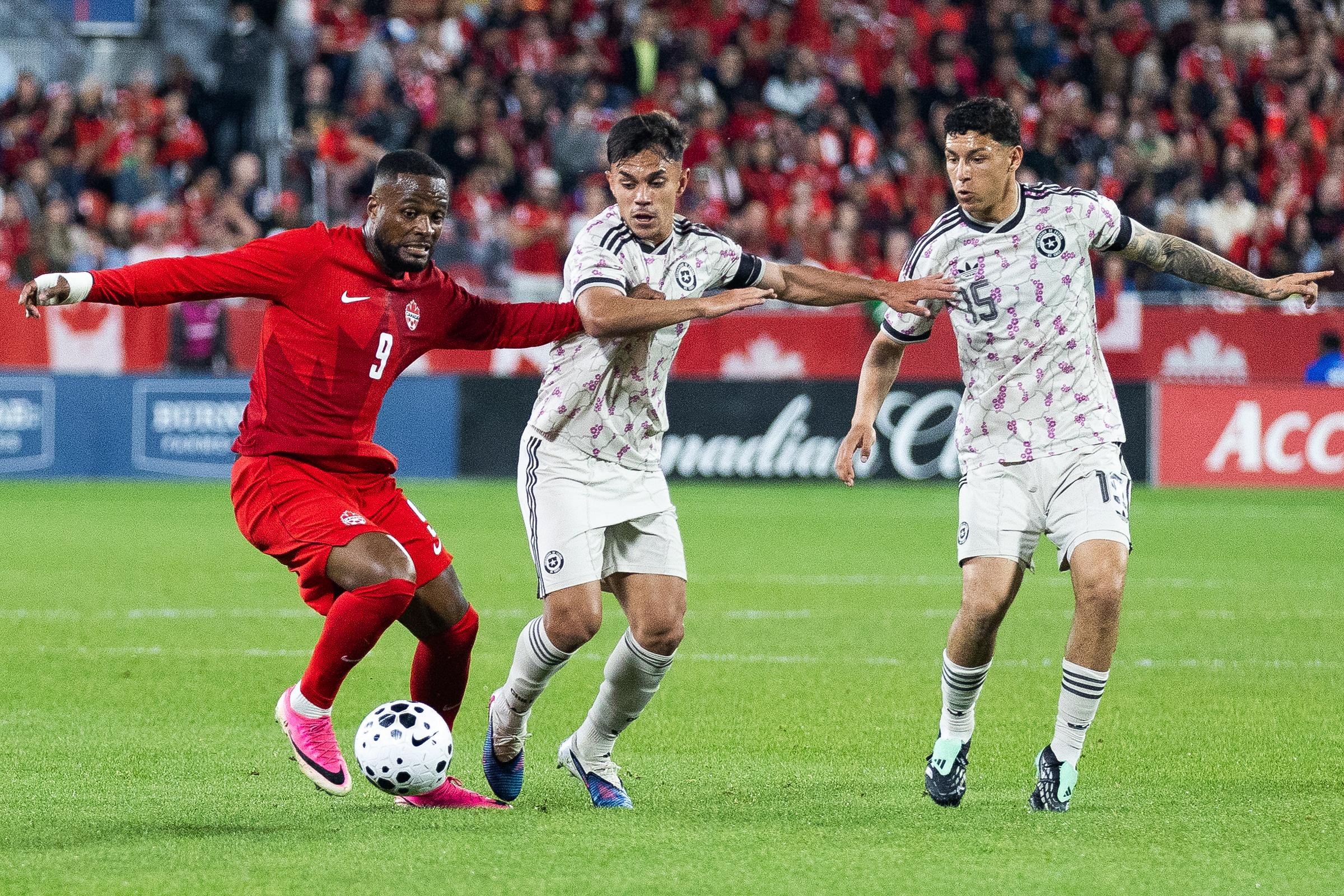
From the outset, Canada's attack controlled the game's progression and rhythm, from the midfielders to the strikers and wingers, for most of the match. Canada controlled 66 percent of possession and attempted 20 shots, six on target, yet came away with only Jonathan David's 12th-minute strike to show for their dominance.
The midfield pair of Mathieu Choinière and Nathan Saliba were masterful at controlling the tempo in the middle of the park and allowing Canada to execute its game plan of attacking from the wings. Canada found more success down the left with Jacob Shaffelburg, whose whipped cross to Larin set up the goal.
The strike partnership of Jonathan David and Cyle Larin also caused considerable trouble for Chile's centre-backs early on. With both strikers coming into the game in excellent form for their respective clubs, it seemed inevitable that more goals would come.

But as the game progressed, the attacks down the wings stagnated somewhat, as the predictability of Canada's tactics allowed Chile to adjust. Tajon Buchanan in particular found himself facing a Chilean wall as he repeatedly tried to beat his man down the right side.
While Larin and David were a handful for Chile's defence, it all seemed to come undone in the final third. At this critical juncture, their attacking movements went awry, and the decisive final touch eluded them. Inexplicably, this became more pronounced as Chile went down to nine men.
Credit must go to Chile's goalkeeper Lawrence Vigouroux, their outstanding performer of the match. He made several critical saves that contributed significantly to Canada's inability to score with a two-man advantage. Yet it remained baffling to players and fans alike that Canada could not find a decisive second goal to put the visitors away.
Canada's flow and rhythm went off the rails with the volume of substitutions in the second half, especially after Jonathan David exited the game. David tended to find open spaces and seams in tight areas. Hoilett's second-half introduction would have been ideal had this been prime Hoilett entering the game. However, on the night Canada Soccer celebrated his international career, it was evident that the former talisman had lost a step and his magic was no longer as potent. Canada has yet to identify a replacement for the creativity Hoilett brought to the team for nearly a decade.
Canada needed to play more on the front foot with the man advantage and find that clinical finish in the final third. Marsch acknowledged post-match: "Chile makes it hard; I don't think the second half was very good."
The challenge of breaking down a low block
This result against nine-man Chile has become a familiar refrain for Canada. The attack remains perplexed by a team that throws up a tight low block and concedes possession. The team did so many things right until the final third, where their link-up play fell short, and when a good chance materialized, the final product fell flat.
The circumstances of the game cried out for a player like peak Hoilett, who was once one of Canada's most effective players at opening up defences that sat back and gave away possession. A competitive game may have seen a centre-back sacrificed for another attacking midfielder, but this was a friendly with eight substitutions to test out new and lesser-used names in the Canadian player pool.
Regardless, beating an opponent that defends deep remains one of Canada's biggest challenges in the Jesse Marsch era.
Much of the discussion focuses on individual players and their form, such as the international scoring droughts of Larin, Buchanan, and others. But the question is whether the Marsch system is conducive to goalscoring. Defensively, the team has been solid; the 20 clean sheets in 38 matches under Marsch attest to that, but are the offensive tactics working? Aside from the 6-0 outburst against nine-man Qatar, goals have been hard to come by for Canada for quite some time.
Fortunately for Marsch and Canada, the next match against Peru is coming up quickly, giving them another chance to refine tactics to break down an opponent in the final third.
'The Homecoming' Squad Update 🍁
— CANMNT (@CANMNT_Official) September 28, 2026
CD Eldense's Justin Smith has been called up to Canada's squad to replace Derek Cornelius due to injury.
A former #CANM20 captain joins #CANMNT camp! 👏 pic.twitter.com/fA1W2eY4Od
Odds and ends
Central midfielder Justin Smith was called up, but curiously the Canada Soccer release stated it was to replace injured centre-back Derek Cornelius rather than fellow central midfielder Jeevan Badwal. Also, near the conclusion of the post-Chile press conference when Jesse Marsch first announced Smith's call-up, he referred to the midfielder as a defender. Where the usually deployed central defensive midfielder lines up for Canada in the next game will be of interest.
Richie Laryea required five stitches above his eye after taking a boot to the head against Chile. How much Laryea can and will play across the final two games of the window remains to be seen, despite finishing most of the game against Chile. Given Laryea's mental toughness, it would be surprising if he didn't feature against Peru.